
BACKGROUND INDUSTRY STANDARDS
Overview of the Scania Industry Standards Transformation
Scania is embarking on a digitalization journey driven by modernization and standardization to meet the demands of the future and better serve the customers of today. As part of this transformation, Scania is transitioning to Industry Standards and implementing a series of changes in its IT landscape, including the current EDI set up and transport labels. With the new ERP system that is implemented as part of the Industry Standards transformation, Scania aims to streamline administrative and transactional processes and to create a modern supply chain collaboration hub with suppliers by enhancing user friendliness, data visibility, and delivery traceability.
Read more about Scania’s Industry Standards transformation in the Vision and Mission Statement.
Which Suppliers are Impacted by Scania’s Industry Standards Transformation?
All automotive parts suppliers supplying to Scania Europe (SEU) are included in the scope for Scania’s Industry Standards Transformation. Classic EDI suppliers are required to develop and test new EDI message versions and labels for different part numbers and Scania units. You will do this in our integrated development and testing platform SEEBURGER, for which you will receive an invite to when starting your onboarding journey.
Depending on which Scania units you are delivering to, you might need to use different systems. For more information about which solution to use before and after go-live, please visit the Go-Live instructions page >> here.
If you are using WebEDI, please visit the Information for Suppliers using WebEDI page for further information >> here.
Two different development and testing journeys: SAP flow and Translator flow
As a supplier, please be aware of two distinct delivery flows. Each flow is associated with a corresponding onboarding campaign used for the development and testing of new EDI messages and Global Transport label (GTL) for that specific flow.
- Translator Flow – covers deliveries to Scania Legacy Production Units. The onboarding campaign includes conducting Legacy testing to enable go-live for the new EDI formats and label via the EDI translator across all Legacy production units (exception: call-offs from Scania Spare parts Centre (CW2, SP4, BW1, LPC) will continue to use the old set-up and label until further notice).
- SAP Flow – covers deliveries to SAP units (NL01 and NL02). The onboarding campaign includes testing the new EDI formats and label to enable go-live for the SAP flow.
Key Changes and Implications for Suppliers
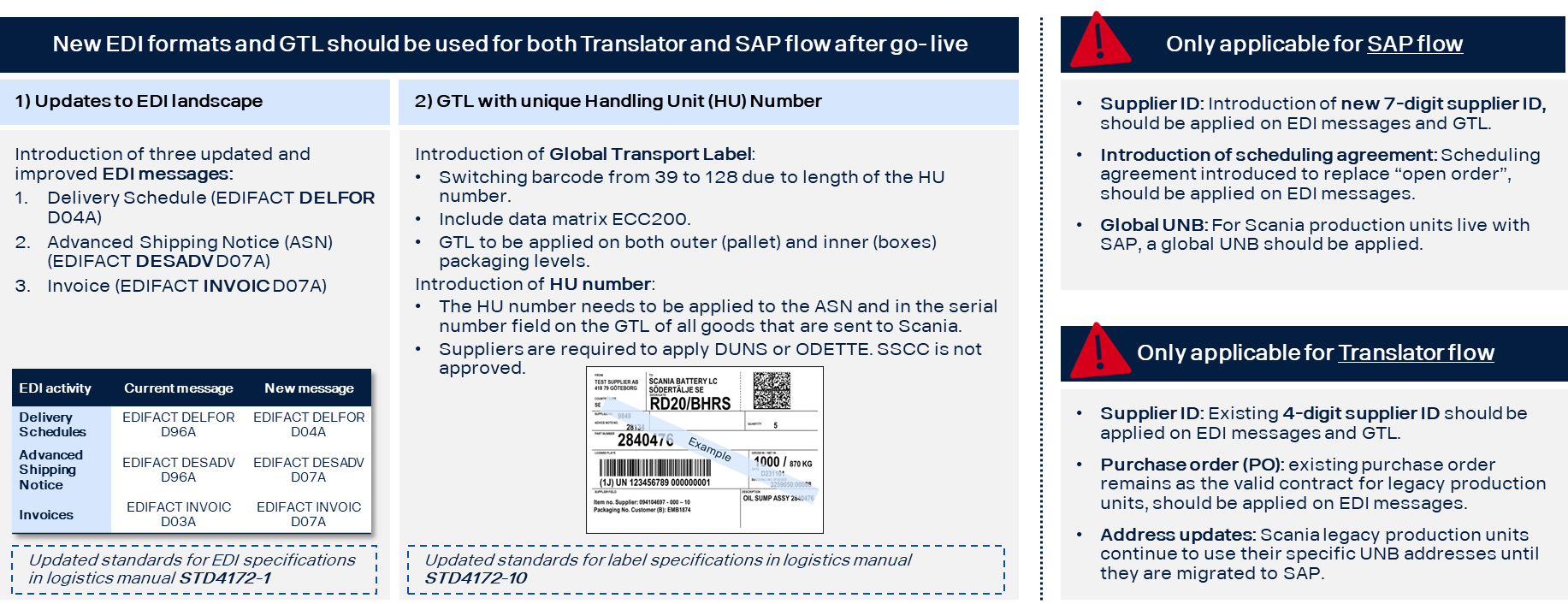
The new EDI formats and GTL will be used in both the Translator flow and the SAP flow after their respective go-lives. However, some updates and considerations apply only to the Translator flow or only to the SAP flow. An overview is provided below:
Supplier Onboarding Journey
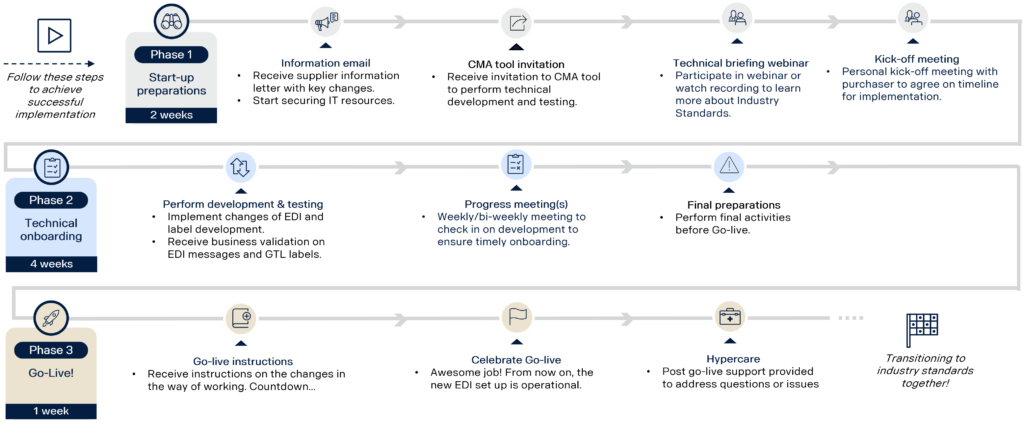
Scania provides an onboarding journey for suppliers to successfully complete the changes in EDI and label setup. Suppliers are supported throughout this journey by the Scania Supplier Readiness Team and are expected to comply with the communicated onboarding timelines.
The onboarding journey for both the SAP flow campaign and the Translator flow campaign for Legacy PRUs look virtually the same.
Scania Industry Standards Transformation Outlook
The Scania Industry Standards Transformation will continue in the upcoming years and all automotive parts suppliers working with Scania will eventually be impacted. Please note that you will be notified by Scania once you are in scope for the transition to industry standards.
The first Industry Standards releases took place for all automative parts deliveries to the Battery Factory (ME) in Södertälje in 2023 and to Scania via Logistic Hub Central Europe (NL01) and Logistic Hub Central Europe / Consolidation Point (NL02 with consignee codes NP2 and SAS) in Q1 2025.